If you are missing a tooth and weighing your replacement options after age 60, you are probably asking one question first: which one will actually last?
A dental implant and a dental bridge both restore a missing tooth, but they age very differently over the years ahead.
Tooth loss is common later in life, and how you replace a tooth affects more than your smile. It affects your bite, your jawbone, and the health of the teeth around the gap.
When comparing dental implant vs bridge longevity, an implant post often lasts longer than a traditional bridge. However, your bone health, gum health, medical history, and daily care all affect how long either restoration may serve you.
Your age alone does not disqualify you from either choice. What matters is your current oral health, how well you heal, and how much bone support your jaw has to work with.
At Florida Dental Implant Center, Dr. Raouf Morcos evaluates your bone support, gum health, neighboring teeth, and treatment goals before recommending an implant or bridge.
Key Takeaways
- A dental implant post often lasts decades, while the crown on top and a traditional bridge usually need replacement every 10 to 15 years.
- Age is not a barrier to implants; bone density, gum health, and how well you heal from surgery matter more than the number on your birth certificate.
- A bridge can still be the practical choice when bone loss, medical conditions, or timeline concerns make implant surgery less appealing.
The Short Answer on Expected Lifespan
A dental implant generally lasts longer than a dental bridge, mainly because the titanium post fuses directly with your jawbone instead of relying on neighboring teeth for support.
That single structural difference explains most of the longevity gap you will read about in this article.
How Long Do Dental Implants Last?
The titanium implant post has a survival rate above 95% at the 10-year mark, and many posts placed decades ago are still working today, according to a retrospective study in 303 partially edentulous patients.
Long-term studies show that many implant posts remain functional for decades.
However, no implant is guaranteed to last for life, and results depend on bone health, gum health, bite forces, smoking, medical conditions, and daily care.
How Long Do Dental Bridges Last?
A traditional dental bridge lasts 10 to 15 years on average before it needs replacement. Because a bridge relies on the two teeth next to the gap (called abutment teeth) for support, its lifespan is tied to the health of those teeth, not just the bridge material itself.
Why the Implant Post and Restoration Have Different Lifespans
The implant post and the crown on top age at different speeds because they face different kinds of wear. The post lives inside bone, protected from the daily forces of chewing that wear down a visible crown.
Replacing an implant crown after 10 to 15 years costs $1,000 to $2,500, while replacing a full bridge in that same window costs $2,500 to $5,000.
Knowing this distinction helps you plan for maintenance costs instead of assuming either option is a one-time expense.
Why Implant and Bridge Design Changes Long-Term Results
An implant and a bridge solve the same problem in very different ways, and that design difference is why their outcomes diverge over time.
One replaces the tooth root directly in the jawbone; the other uses prepared neighboring teeth to support a replacement tooth across the gap.
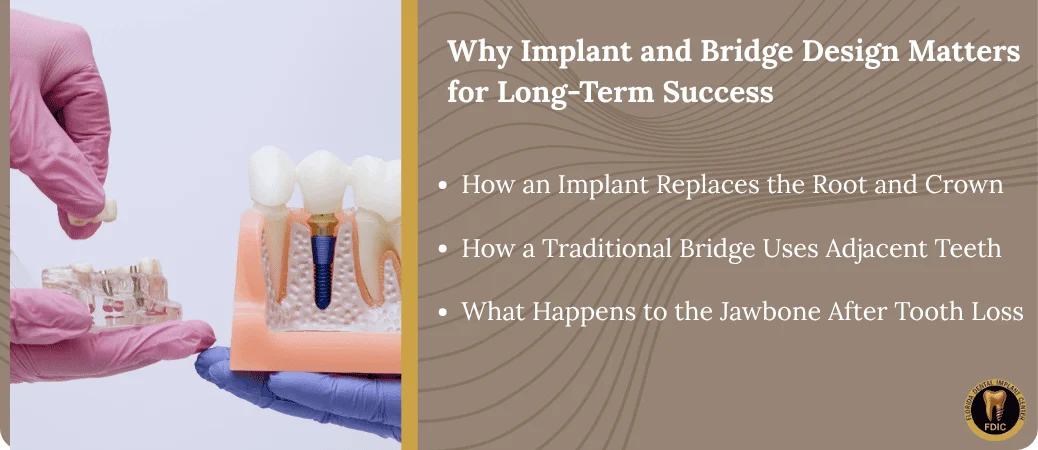
How an Implant Replaces the Root and Crown
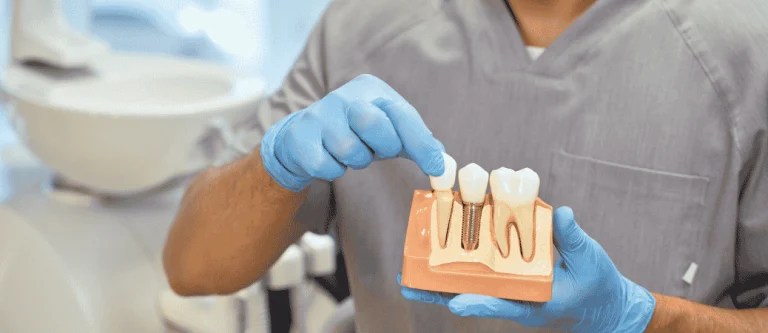
A single-tooth dental implant is built from a titanium post that acts as an artificial tooth root. It is topped with an abutment, which is a small connector, and a custom dental crown that forms the visible replacement tooth.
Once the post is placed, it gradually bonds with the surrounding bone through a process called osseointegration. This process allows the implant to stand independently without relying on the neighboring teeth for support.
How a Traditional Bridge Uses Adjacent Teeth
A traditional dental bridge fills the gap using an artificial tooth, called a pontic, supported by crowns placed on the neighboring teeth.
Preparing these supporting teeth requires removing some enamel so the crowns can fit properly.
If decay, fracture, or gum problems later affect a supporting tooth, the bridge may need repair or replacement, and the tooth may require additional treatment.
What Happens to the Jawbone After Tooth Loss
Losing a tooth root triggers bone loss, also called bone resorption, in the area where the root used to be.
Understanding what happens when implant treatment is delayed can help explain why replacing a missing tooth sooner may preserve more treatment options.
An implant transfers chewing forces to the surrounding bone and may help preserve bone at the treatment site. A traditional bridge replaces the visible tooth but does not replace its root.
Changes in the underlying gum and bone can also affect the appearance and fit of the bridge over time.
What Matters Most When You Are 60 or Older
Your age does not disqualify you from getting a dental implant. What matters is whether your jawbone, gums, and overall health can support the healing process, which is why a thorough exam matters more than a birthday.
Does Age Ever Make Someone Too Old for Dental Implants?
There is no upper age limit written into implant guidelines. Older adults may qualify for dental implants when their oral health, bone support, and general health allow predictable healing.
How Bone Density and Bone Grafting Affect Candidacy
Bone volume can decline after a tooth has been missing for an extended period, and an implant needs adequate support to remain stable.
However, dental implants with bone loss may still be possible after a detailed evaluation.
When the jawbone is too thin or short at the planned implant site, bone grafting may help prepare the area for future implant placement.
Whether grafting is needed depends on your anatomy, implant position, and treatment plan.
Why Medical History, Gum Health, and Healing Need Review
Gum disease, uncontrolled diabetes, and certain medications can all slow healing and raise the risk of complications like peri-implantitis, an infection around the implant that can lead to bone loss.
Gum recession also changes how much support your teeth or an implant have at the gumline.
An experienced implant dentist can review your medical history, bone levels, gum health, and neighboring teeth before recommending an implant, bridge, or another replacement option.
When Each Option May Make More Sense
Neither implants nor bridges are the automatic right answer for every patient over 60.
The better long-term choice depends on your bone health, the condition of your neighboring teeth, and how many teeth need replacing.
When an Implant May Be the Better Long-Term Choice

An implant tends to make sense when your adjacent teeth are healthy and you would rather leave them untouched.
It also suits patients with adequate jawbone health, since the post needs solid bone to fuse with for long-term stability.
If bone volume is limited, an evaluation can determine whether bone grafting or another implant approach may make treatment possible.
When a Bridge May Be the More Practical Choice
A bridge can be the more practical option if the teeth next to the gap already need crowns for other reasons, since the bridge uses restorations you would need anyway.
A bridge generally requires a shorter treatment process because implant surgery and osseointegration are not involved.
Implant treatment may take several months, and the schedule can be longer when extraction, bone grafting, or additional healing is needed.
What to Consider for Multiple Missing Teeth
Multiple missing teeth change the calculation for both options. A longer bridge places more strain on fewer supporting teeth, while multiple implants (or an implant-supported bridge) can distribute bite forces more evenly across the jaw.
Patients missing several teeth in a row often benefit from exploring implant-retained denture options or full-arch solutions, which can restore function without overloading remaining natural teeth.
Comparing Treatment Time, Cost, and Ongoing Care
An implant generally involves a longer treatment timeline and a higher upfront cost, but often a lower total cost over decades.
A bridge is faster and cheaper at the start but usually needs replacement sooner, sometimes more than once over a 30-year span.
| Factor | Dental implant | Dental bridge |
| Treatment process | Requires implant placement and healing before the final crown in many cases | Usually completed without implant surgery |
| Initial cost | Varies by imaging, grafting needs, implant components, and restoration | Varies by the number of replacement and supporting teeth |
| Longevity | The post may last for decades, while the crown may eventually need replacement | May last many years but depends heavily on supporting teeth |
| Future expenses | May include crown repair, replacement, or implant maintenance | May include replacement or treatment of supporting teeth |
| Neighboring teeth | Usually does not require reshaping adjacent healthy teeth | A traditional bridge requires reshaping supporting teeth |
What Is the Treatment Timeline for Each Option?
A bridge generally has a shorter treatment process because implant surgery and osseointegration are not required.
Implant treatment may take several months, especially when extraction, bone grafting, or additional healing is needed.
How Upfront and Long-Term Costs Can Differ
Treatment costs depend on the type of restoration, materials used, and whether procedures such as bone grafting are needed.
Florida Dental Implant Center is a private, out-of-network practice and does not participate in dental insurance networks.
The team can provide standard claim forms for patients to submit directly to their insurer for possible reimbursement.
Financing options are also available through CareCredit, Cherry, and Proceed Finance, subject to approval and the provider’s terms.
How to Protect an Implant or Bridge for as Long as Possible
Good oral hygiene extends the life of either option. Bridges need floss threaders or interdental brushes to clean under the pontic, since regular floss cannot reach that space and plaque buildup there can damage the abutment teeth.
Implants are cleaned much like natural teeth, but they still need daily attention to prevent peri-implantitis, and teeth grinding can put excess bite force on either restoration if it goes untreated.
Choosing the Replacement That Fits Your Health and Goals

The right choice between a dental implant and a dental bridge comes down to your jawbone health, the condition of your supporting teeth, and how much you value long-term bone preservation versus a shorter treatment timeline.
Both options can restore your smile and your ability to chew comfortably, but they carry different long-term consequences for your mouth.
If your bone density is solid and your neighboring teeth are healthy, an implant often protects both your jawbone and your natural teeth for the years ahead.
If your medical history, budget, or timeline point toward a bridge, that option can still serve you well, especially when the adjacent teeth already need restorative work.
At Florida Dental Implant Center, Dr. Raouf Morcos can review your imaging, oral health, and treatment goals to explain which option is better suited to your needs.
Frequently Asked Questions
Should seniors get dental implants?
Many seniors are excellent candidates for dental implants, as long as their jawbone and gum health can support healing.
Age alone does not rule out treatment; a full exam of your bone density, medical history, and healing capacity gives a clearer answer than your birth year does.
At what age should you stop getting dental implants?
There is no set age when implants become off-limits. Healthy adults in their 80s and beyond can receive implants successfully if their bone quality and overall health support the healing process.
Why would a dentist recommend a bridge instead of an implant?
A dentist may recommend a bridge if your neighboring teeth already need crowns, if you have limited jawbone density and prefer to avoid a bone graft, or if a medical condition makes surgery riskier.
A bridge also finishes faster, which matters for patients who want a quicker fix.
Why is a dental bridge not recommended in some cases?
A bridge is sometimes discouraged when the adjacent teeth are healthy, since the procedure requires removing enamel from those teeth permanently.
It is also less ideal when significant bone loss has already occurred under the missing tooth, since a bridge does nothing to stop that bone loss from continuing.
Can dental implants last a lifetime after age 60?
The implant post itself can often last 25 years or longer, and many patients keep the same post for life once it fuses with the jawbone.
The crown on top usually needs replacement every 10 to 15 years due to normal wear from chewing.
Do I need a bone graft before getting a dental implant?
A bone graft is only needed if imaging shows your jawbone lacks enough density or volume to support the implant post securely.
Patients who have worn dentures for years or have lived with missing teeth may have reduced bone volume.
Learning about jawbone changes after long-term denture use can explain why diagnostic imaging is needed before deciding whether grafting or another approach should be considered.