Being told you have bone loss does not have to end your plan for fixed teeth.
Many people who were turned down for traditional dental implants can still get a full arch of teeth, because the placement strategy changes instead of the bone.
Patients researching All-on-X without bone graft usually want to know whether existing jawbone can support a fixed full-arch restoration.
In some cases, carefully planned implant positions and angled rear implants can use available bone and reduce or remove the need for grafting.
However, eligibility depends on 3D imaging, bone volume, implant stability, oral health, and the location of nearby nerves and sinuses.
Angled implant placement in the strongest remaining bone lets many patients with moderate bone loss skip grafting entirely, though severe upper-jaw loss still calls for a different plan.
This is a real option for full-arch tooth replacement, not a loophole. It still involves implant surgery, healing time, and a real financial investment.
What it changes is the number of procedures you need before you can chew again.
Key Takeaways
- The number and angle of implants get customized from your 3D scan, so “X” rarely means a fixed count of four.
- Most patients with moderate bone loss avoid grafting, while severe upper-jaw loss may need zygomatic implants or another plan.
- A no-graft plan shortens treatment time and cost, but daily cleaning and checkups protect the result long-term.
Table of Contents
- How the All-on-X Protocol Can Avoid Grafting
- Who May Qualify for a No-Graft Full-Arch Plan?
- What Happens During Treatment and Recovery?
- Costs, Alternatives, and Long-Term Considerations
- A Personalized No-Graft Path to Fixed Teeth
- Frequently Asked Questions
How the All-on-X Protocol Can Avoid Grafting
All-on-X avoids grafting by working with the bone you already have instead of building new bone first.
Implant posts get placed in the front and middle of the jaw, where bone stays denser after teeth are lost, and the back implants get tilted to catch more of that solid bone.
All-on-X uses multiple implants to support a fixed full-arch restoration.
Florida Dental Implant Center describes its approach as using four to six implants, with the exact number based on the patient’s anatomy and treatment plan.
Why “X” Can Mean More Than Four Implants
The “X” stands for the number of implants your case needs. That number comes from your scan, your bite force, and the shape of your jaw.
All-on-4 dental implants use four posts. Many plans use five or six. Clinical planning teams decide the count based on available bone, esthetic needs, chewing forces, and long-term prognosis.
More implants can spread out pressure. That helps if you clench hard or have softer bone in one area. Fewer implants can work well when the bone is strong and the bite is balanced.
Your All-on-X treatment plan should name the number and the reason behind it.
How Angled Implant Placement Uses Available Jawbone
When back teeth are lost, the bone behind them thins out first. The front of the jaw holds its shape longer, and the upper jaw has sinus cavities sitting above the back teeth.
Tilting the rear implants forward lets a longer implant sit inside that stronger front-and-middle bone while the top of the post still emerges near the back of the arch.
The angulation optimizes contact with existing bone and often removes the need for grafting.
You get support for back teeth without adding bone where the sinus sits. If you want the fuller picture on why the jaw shrinks after tooth loss, our post on dental implants with bone loss covers it.
When Immediate Loading and Temporary Teeth Are Possible
Immediate loading means temporary teeth may be attached on the day of implant placement when the implants achieve adequate stability and the clinical conditions are suitable.
Soft bone, an infection at the site, or a heavy grinding habit can push loading back a few weeks. Your surgeon tests each implant’s grip before deciding. Same-day prosthetic teeth are common in these cases.

Who May Qualify for a No-Graft Full-Arch Plan?
You are likely a candidate if your 3D scan shows enough bone height and width in the front of the jaw, your gums are free of active infection, and your general health supports healing.
Low bone density in the back of the arch rarely disqualifies you on its own.
Two things settle the question: what the scan shows, and how your body heals.
What CBCT Scans Reveal About Bone Volume and Density
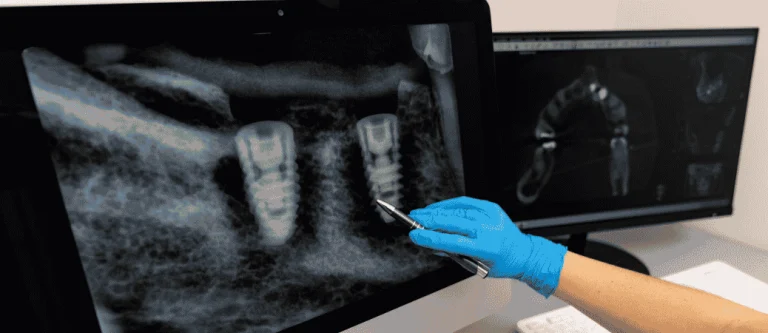
A CBCT scan is a 3D X-ray of your jaws. Flat X-rays show height. A CBCT provides three-dimensional information about jawbone shape, height, width, and its relationship to nearby nerves and sinuses.
That detail lets your implant dentist measure each planned implant site in millimeters before any surgery happens. It also shows where the bone is dense enough to hold a tilted implant.
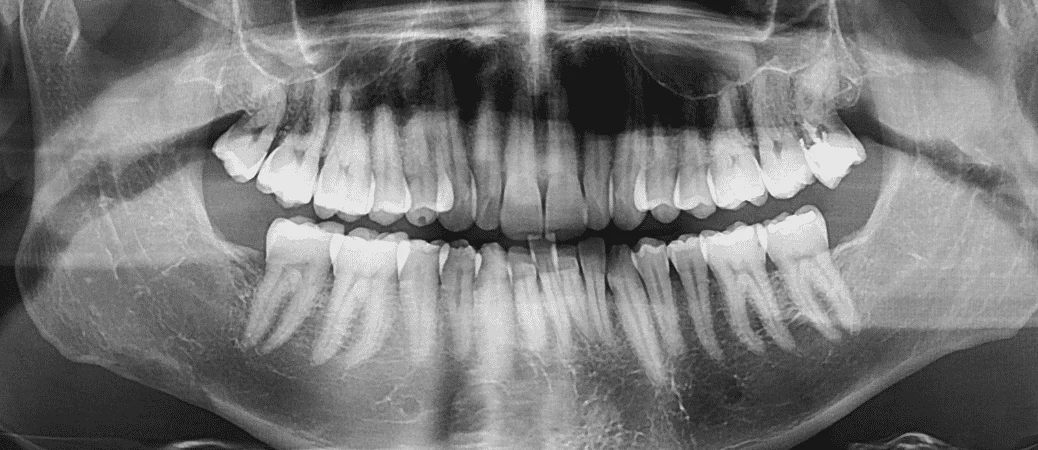
Three-dimensional imaging can provide more detailed information than a panoramic X-ray when planning implant positions. The dentist will select the imaging needed for your case.
If a plan was quoted without a CBCT, that is a fair reason to ask for a second opinion.
Health Factors That Can Affect Implant Healing
Active gum disease needs treatment before implants go in. Periodontitis brings bacteria that attack the tissue around a new implant, and the same bacteria caused much of the bone loss in the first place.
Smoking can interfere with healing and raise the risk of implant complications. Your dentist can explain when nicotine use should stop before and after treatment.
Uncontrolled diabetes delays healing too. Well-managed blood sugar puts most patients back in the running.
Your medical history gets reviewed alongside your scan, and the doctors at Florida Dental Implant Center will tell you which items need attention first.
When Severe Upper-Jaw Bone Loss Calls for Zygomatic Implants
Some upper jaws have lost so much bone that even a tilted implant cannot find purchase. In those cases, oral surgeons can anchor implants in the zygoma, the cheekbone, which stays dense throughout life.
Zygomatic implants are longer and require advanced surgical training. They let patients with almost no upper jawbone receive a full arch with immediate fixed teeth and no traditional graft.
This is a bigger surgery than standard All-on-X. It belongs in the conversation only when standard placement has been ruled out on your scan.
What Happens During Treatment and Recovery?
Treatment runs in three stages: digital planning, one surgical day that includes extractions and temporary teeth, and a healing stretch of about four to six months before your final teeth go on.
Most of the precision happens before you sit in the chair.
Digital Planning and Guided Surgery
Your CBCT gets merged with a digital scan of your mouth. The team then positions each implant on screen, checking depth, angle, and clearance from your sinus and nerves.
That plan can be turned into a surgical guide, a custom template that fits over your jaw and directs each drill to the planned spot.
Guided surgery reduces surprises during the procedure and helps the implants land where the prosthetic teeth need them.
Implant Surgery, Extractions, and Same-Day Teeth
On surgery day, any failing teeth come out first. The bone ridge gets smoothed, the implants go in, and abutments connect them to your temporary bridge.
Expect swelling that peaks around day two or three, then eases. You will eat soft foods for several weeks so the implants stay undisturbed while bone grows around them.
Most people return to desk work within a few days. Chewing ability comes back gradually, and speech usually adjusts within the first couple of weeks as your tongue learns the new shape.
Osseointegration and the Final Prosthesis
Osseointegration is the process where your bone grows tightly against the titanium surface and locks each implant in place. It takes roughly three to six months.
Once your scan confirms integration, the temporary bridge comes off and your permanent prosthetic teeth get made from stronger materials such as zirconia.
This final dental restoration is thinner, better polished, and shaped for the way your bite settled during healing.
Costs, Alternatives, and Long-Term Considerations
All-on-X costs vary according to the number of implants, required extractions, imaging, sedation, temporary restoration, and final restoration material.
Avoiding grafting may reduce the number of procedures, but it does not automatically place treatment within a particular price range. Request a written estimate based on your recommended treatment plan.
How Much Does a No-Graft All-on-X Treatment Cost?
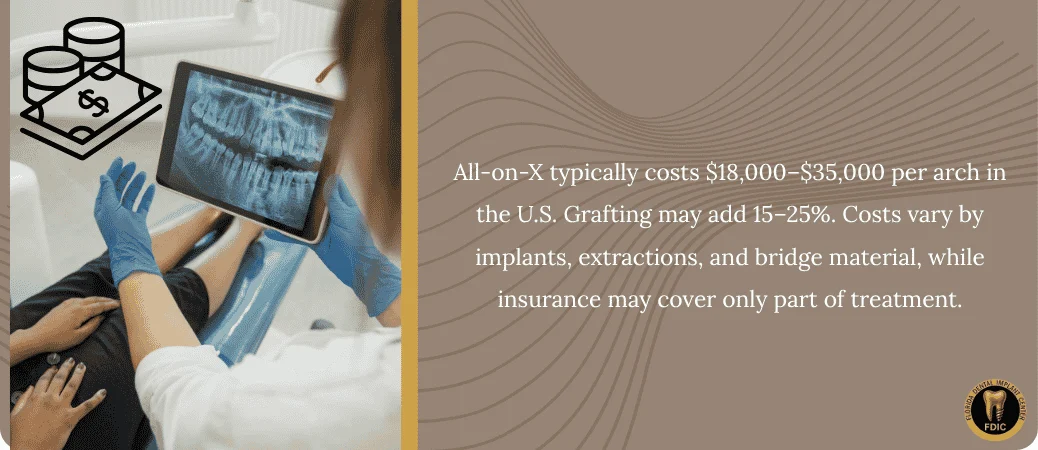
The average total cost for All-on-X in the U.S. ranges from $18,000 to $35,000 per arch, covering surgical fees, implant hardware, and the prosthetic bridge.
Added procedures like grafting can raise that by 15 to 25 percent.
Your number moves with the implant count, the extractions needed, and the material in your final bridge.
Florida Dental Implant Center is a private, out-of-network practice and does not participate in dental insurance networks.
Patients with dental insurance can request standard claim forms and submit them directly to their insurer for possible reimbursement.
Financing options are available through CareCredit, Cherry, and Proceed Finance, subject to approval and provider terms.
How All-on-X Compares With Dentures and Individual Implants
| Factor | All-on-X | Removable dentures | Individual implants |
| Support | Multiple implants support a fixed full arch | Rests on the gums | Each restoration has its own implant support |
| Removable by patient | No | Yes | No |
| Bone grafting | May not be needed in some cases | Not required for denture placement | Depends on bone at each implant site |
| Treatment time | Varies according to healing and additional procedures | Varies by the denture process and oral condition | Varies by the number of implants and healing needs |
| Cost | Based on implant count, surgery, and restoration | Based on denture type and preparatory care | Based on implant count and restorations |
Traditional dentures cost the least and need no surgery, but they rest on gums that keep shrinking.
For patients who are not candidates for a fixed full arch, implant-retained dentures may provide greater stability than traditional removable dentures.
Individual implants replace each tooth separately and give the most natural result, though full arches of them need 3 to 6 months of osseointegration and usually more bone.
If you have worn removable dentures for years, learn how long-term denture use can affect implant planning before discussing your options.
When Grafting, a Sinus Lift, or Another Option Is Still Better
Grafting is the better choice when your scan shows too little bone in the front of the jaw for angled implants to anchor.
A sinus lift adds bone height under the sinus floor; ridge augmentation widens a knife-edge ridge.
Both add volume where nature took it away, and sinus lifts and ridge augmentation remain standard when resorption is advanced.
Mini dental implants are another route for stabilizing a lower denture at lower cost, with less strength for a fixed bridge.
Waiting has a price too. The longer you go without treatment, the more the ridge resorbs, which is one of the consequences of delaying dental implants.
Protecting Your Investment After Full-Arch Treatment
Peri-implantitis is the main long-term threat. It is gum and bone inflammation around an implant, driven by plaque that sits under the bridge where a toothbrush cannot reach.
A water flosser aimed along the gum line under the prosthesis clears that space in about a minute a day.
Use the cleaning tools recommended by your dental team and attend examinations at the interval selected for your implant health.
Professional maintenance may include cleaning around and beneath the restoration when clinically appropriate.
If you grind your teeth, a custom night guard protects the prosthetic teeth from cracking. Patients who keep up this routine report high satisfaction with chewing, speech, and the support the arch gives their facial structure.
A Personalized No-Graft Path to Fixed Teeth
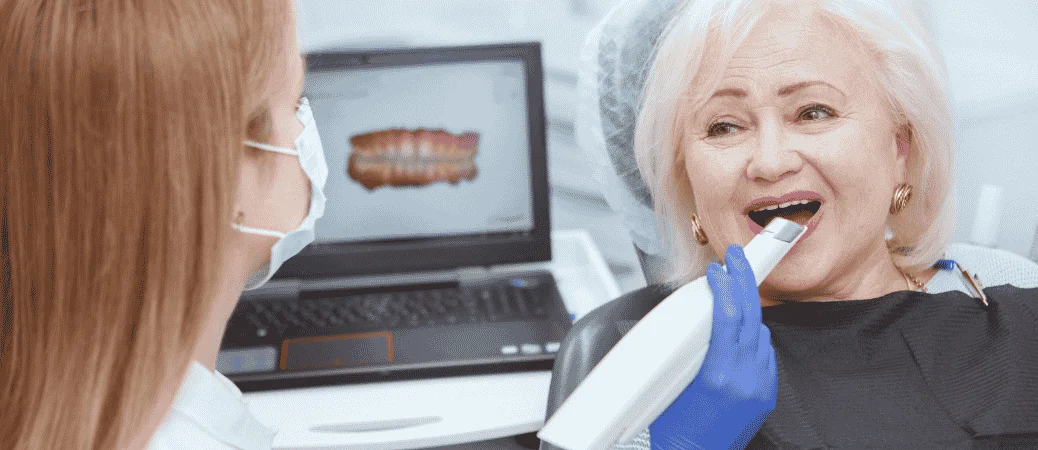
Dental implants without bone grafting are realistic for most patients with moderate bone loss, because All-on-X adjusts the implant count and angle to the bone you have.
Severe upper-jaw bone loss may require a different implant strategy, grafting, or referral for advanced treatment. A detailed evaluation is needed to identify an appropriate option.
Frequently Asked Questions
Do all All-on-X dental implant cases avoid bone grafting?
No. Most patients with moderate bone loss avoid grafting because the back implants get angled into denser bone. Cases with severe resorption in the front of the jaw still need grafting or a different approach.
Can I get All-on-X implants if I have severe bone loss?
Often yes, though the plan changes. Severe upper-jaw loss may call for zygomatic implants anchored in the cheekbone, while severe lower-jaw loss may need grafting first. Your CBCT scan determines which route applies.
Are All-on-4 and All-on-X the same treatment?
They use the same protocol, with one difference. All-on-4 always uses four implants; All-on-X lets the count vary, commonly four to six, based on your bone, bite force, and restorative goals.
How long does no-graft All-on-X treatment take?
Implant placement and temporary teeth may be completed on the same day when adequate implant stability is achieved. Healing generally continues for several months before the final restoration is placed.
What happens if there is not enough bone for angled implants?
Your options shift to zygomatic implants for the upper jaw, bone grafting with a sinus lift or ridge augmentation, or an implant-retained overdenture.
Each gets weighed against your health, budget, and how much surgery you want.
Does dental insurance cover All-on-X implants without bone grafting?
Dental insurance rarely covers a full arch in full. Many plans contribute toward extractions or part of the prosthesis, and annual maximums often cap benefits well below the total.
Ask your carrier for a pre-treatment estimate.