A tooth can become painful, break unexpectedly, or develop an infection. Sometimes, a filling, crown, or root canal can restore it. In other cases, the damage may be too extensive for a simple repair.
However, choosing the best dental practice ensures a thorough examination and diagnostic imaging to determine how much healthy tooth structure remains.
Your dentist also evaluates your pain, bone support, infection, and the condition of the surrounding tissues before recommending treatment.
Extraction is generally considered only when the tooth cannot be predictably restored or keeping it could place your oral health at risk.
Understanding the signs you need a tooth extraction will help you seek immediate professional care before the pain, infection, or structural damage becomes more difficult to manage.
Table of Content
- 1) Severe tooth decay leaving too little healthy structure
- 2) A vertical root fracture or deep split extending below the gumline
- 3) Repeated infections or an abscess that returns after treatment
- 4) Advanced gum disease causing significant bone loss and looseness
- 5) A tooth that remains loose despite appropriate periodontal treatment
- 6) Extensive damage from trauma that cannot support a filling or crown
- 7) Persistent pain and inflammation after root canal treatment
- How Dentists Evaluate Whether a Tooth Is Restorable
- What to Expect If Extraction Is Recommended
- Frequently Asked Questions
1) Severe tooth decay leaving too little healthy structure
Sometimes decay eats away so much of your tooth that there just isn’t enough left to fix. A filling needs healthy tooth structure to bond to, so when decay affects most of the tooth, fillings become unreliable.
Think of your tooth like a house. If the foundation crumbles, you can’t just patch the walls and call it done.
Even a crown, which covers the whole tooth, needs something solid underneath to attach to. If decay has hollowed out too much of the tooth, a crown won’t have anything stable to grip onto.
Your dentist will check how much healthy tooth remains before deciding on treatment. If the decay has spread deep into the tooth and destroyed the support structure, extraction may be your safest option.
Left untreated, this kind of decay usually gets worse. It can also open the door to infection, which creates a whole new set of problems for your mouth.
Catching decay early gives you way more options. Waiting too long can turn a simple filling into a much bigger decision down the road.
2) A vertical root fracture or deep split extending below the gumline
A vertical root fracture is a crack that runs along the length of your tooth’s root. It often starts small and can be very hard to spot, since it hides below the gumline where you can’t see it.
If your dentist finds a fracture that reaches below your gumline, the outlook usually isn’t good. This type of crack can’t be sealed off or fixed, since it goes too deep for a filling or crown to help.
You might notice pain when you chew or bite down, though some people don’t feel any symptoms at all. This is one reason why these fractures can be tricky to catch early.
Once the crack extends below the gum, bacteria can slip inside and cause an infection around the root.
Since the damage can’t be reversed, your dentist will likely recommend an oral surgery to remove the tooth and rotect the bone and gum tissue around it.
Catching this problem early gives you more options, so regular checkups really do matter.
3) Repeated infections or an abscess that returns after treatment
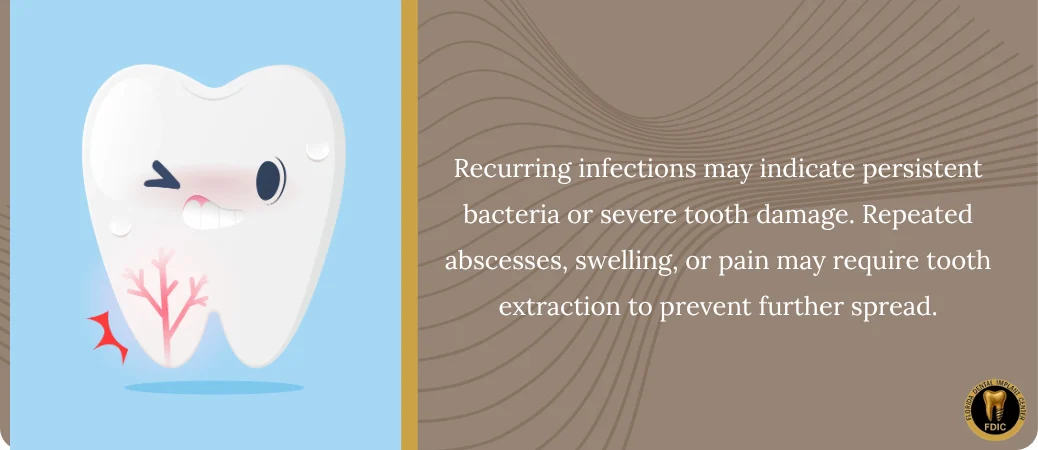
If you keep getting infections in the same tooth, that’s a warning sign. Your dentist may treat an abscess with antibiotics or drain it, but if it comes back again and again, the tooth may be too damaged to fix.
A repeat infection often means bacteria have found a way to stay inside the tooth or the surrounding bone. Even a root canal can fail to solve the problem if the infection has spread too far.
In some cases, chronic infections can spread deep into the jawbone and threaten nearby teeth, which makes the problem harder to control.
You might notice swelling, pain, or a bad taste each time the infection flares up. This cycle can wear down your immune system and your patience. It also puts other teeth at risk if the infection spreads.
When an abscess keeps returning after treatment, your dentist may recommend removing the tooth.
This can stop the infection from spreading and protect your overall health. It’s not a fun choice, but sometimes it’s the safest one for your smile.
4) Advanced gum disease causing significant bone loss and looseness
Gum disease doesn’t just affect your gums. Over time, it can eat away at the bone that holds your teeth in place.
When this happens, your teeth may start to feel wiggly or shift out of position. This is a sign of gum disease bone loss, and it usually means the damage has been happening for a while.
Here’s the tricky part: bone loss often doesn’t hurt in the early stages. You might not notice anything is wrong until your teeth start to move.
Once you reach advanced periodontitis, the damage is typically permanent. At this point, treatment focuses on managing the progression of gum disease stages rather than reversing it.
If your dentist tells you a tooth has significant bone loss, they’re checking for stability. A tooth with too little bone support may not be able to handle chewing forces anymore, even with treatment.
Deep pockets, receding gums, and heavy bleeding are also common warning signs. According to Johns Hopkins Medicine, this stage can involve major bone and tissue loss severe enough that a tooth needs to be removed.
5) A tooth that remains loose despite appropriate periodontal treatment
Sometimes you do everything right. You go through cleanings, follow your dentist’s advice, and stick to a good oral care routine. But your tooth still feels loose.
This is a sign that things are more serious. It usually means the bone and tissue holding the tooth in place have broken down too much to fix.
When gum disease has caused too much bone loss, even good treatment cannot bring back what’s gone.
Your dentist may try more than one method to save the tooth. This can include scaling and root planing, splinting the tooth to its neighbors, or even bone grafts.
If none of these treatments make the tooth more stable after a few months, it’s a strong signal that saving it may not be possible.
At this point, extraction often becomes the safer choice. A loose tooth that stays loose can lead to more bone loss, gum infection, or damage to nearby teeth.
At Florida Dental Implant Center, Dr. Hany Gabriel will evaluate your gum health, review diagnostic images to assess bone support, and check how the tooth has responded to previous treatment.
If the tooth cannot be stabilized or restored, removing it may help protect the surrounding teeth and prevent further pain or infection.
6) Extensive damage from trauma that cannot support a filling or crown
Sometimes an accident or injury breaks a tooth so badly that a filling or crown just won’t work. If a crack goes deep below your gum line, there may not be enough healthy tooth left to hold a repair in place.
Your dentist checks for severe fractures below the gum line to see if the tooth can still be fixed. When a break is too deep or too wide, there isn’t a stable base left to attach a crown to.
A crown needs a strong foundation to stay in place. When the tooth structure is too weak to support one, your dentist will likely suggest removing the tooth instead.
If you’ve had a hard hit to the mouth, get it checked out right away. Waiting can let infection set in or make the damage worse.
Your dentist will take X-rays and look closely at the tooth to see how much of it can be saved. If too little remains, extraction is usually the safest choice for your oral health.
7) Persistent pain and inflammation after root canal treatment

A root canal is supposed to stop your tooth pain for good. If your tooth still hurts weeks or months later, something may be wrong.
Some soreness right after treatment is normal. Your gums and jawbone need time to heal, and this can cause mild pressure or tenderness for a few days.
But pain that keeps coming back is a different story. It could mean bacteria are still inside the tooth or the infection has spread further.
Watch for swelling in your gums or face, too. This can point to an infection that never fully cleared up.
Sometimes a tooth can be treated again with a procedure called retreatment. Your dentist cleans out the canals and tries to remove any leftover bacteria.
But retreatment does not always work. If the infection keeps returning, or if the root has cracked or bone around it has broken down, your dentist may recommend pulling the tooth.
This protects the rest of your mouth from more damage. If your root canal tooth still hurts, don’t ignore it. Talk to your dentist so they can find out what’s really going on.
How Dentists Evaluate Whether a Tooth Is Restorable
When you have a damaged tooth, your dentist will look at several things before deciding if it can be fixed or needs to come out. This process involves careful checks and weighing your treatment options.
Diagnostic Imaging and Clinical Examination
It starts with X-rays to see what’s happening below the surface. These images show the health of the tooth root, the bone around it, and how deep any decay goes.
During your visit, your dentist also checks the tooth by hand. They look for cracks, test if the tooth feels loose, and check how deep your gums are around the tooth.
Complete evaluation requires X-rays and a clinical exam to build a full picture of your tooth’s health. This helps them figure out things like:
- How much healthy tooth structure remains
- Whether the crack goes below the gum line
- If there’s enough bone to support the tooth long-term
- Whether infection has spread to nearby teeth
Restorative Options Before Extraction
Before your dentist even talks about pulling a tooth, they’ll usually try to save it first. Many teeth that look badly damaged can still be repaired with the right treatment.
A filling, crown, or root canal are often the first choices your dentist will consider. Each option works best for different levels of damage:
| Treatment | Best For |
| Filling | Small to moderate cavities |
| Crown | Weakened or cracked teeth |
| Root canal | Infection that reaches the nerve |
Your dentist will pick the simplest option that gets the job done. If none of these can restore your tooth safely, they’ll talk to you about why extraction might be the better choice for your long-term health.

What to Expect If Extraction Is Recommended
If your dentist tells you a tooth needs to come out, you can expect a short procedure followed by a recovery period and a plan to fill the gap. Knowing what happens before and after can help you feel more at ease.

Preparing for the Procedure
When having a tooth extraction performed by an experienced dentist, proper preparation helps make the procedure safer and more comfortable.
Before treatment, your dentist will review your medical history, discuss any medications you take, and use X-rays to assess the tooth’s position and surrounding bone.
On the day of the extraction, you will be given sedation to numb the treatment area. You may feel some pressure during the procedure, but you should not feel sharp pain.
Here is what to plan for:
- Eat a light meal before your appointment, unless told otherwise.
- Arrange a ride home if you are getting sedation.
- Wear comfortable clothing and you don’t mind getting a little messy.
- Ask about any medication changes ahead of time.
Most simple extractions take less than an hour to complete.
Replacing a Missing Tooth After Healing
Once your gum and bone have healed, you and your dentist can talk about ways to fill the space. Waiting too long can let nearby teeth shift, so it helps to plan early.
Common options include:
| Option | What It Involves |
| Dental implant | A small post placed in the jaw with a crown on top |
| Bridge | A false tooth held in place by neighboring teeth |
| Partial denture | A removable piece that fills one or more gaps |
Your dentist will guide you toward the option that fits your mouth, budget, and daily habits. If the missing tooth shows when you smile, a cosmetic dentist can help make sure your crown, bridge, or implant blends in naturally with the rest of your teeth.
Frequently Asked Questions
Here are answers to common questions about tooth damage, extractions, and what to expect when a tooth is beyond repair.
How can I tell if a tooth is too damaged to save?
You’ll usually notice a mix of warning signs, like ongoing pain, swelling, or a tooth that feels loose. Cracks that go below the gumline or decay that has eaten away most of the tooth structure are also red flags.
Your dentist can check for severe infection and bone loss using X-rays. This helps them see problems you can’t spot on your own.
When is a root canal no longer an option for a tooth?
A root canal works when there’s enough healthy tooth left to support a filling or crown. But if the crack extends below the gumline or splits the root vertically, there’s nothing left to save.
Root canals also won’t help if infections keep coming back even after treatment. At that point, extraction becomes the safer choice for your health.
What types of tooth damage usually require extraction?
Deep vertical fractures that split the root are one of the most common reasons for extraction. Severe decay that leaves too little healthy tooth structure to work with is another.
Gum disease that has caused major bone loss can also make a tooth too weak to keep. In these cases, your dentist may recommend pulling the tooth before more damage occurs to nearby teeth or bone.
Can a severely decayed or broken tooth still be repaired?
Sometimes, yes. If enough healthy structure remains, your dentist may be able to use a filling, crown, or root canal to save it.
But once decay reaches the root or the tooth has fractured badly, repair options run out. Your dentist will look at how much healthy tooth is left before making a recommendation.
What happens if I wait to remove a tooth that cannot be saved?
Waiting can let infection spread to nearby teeth, gums, or even your jawbone. Pain and swelling often get worse the longer you put off treatment.
You could also lose more bone around the tooth, which makes future tooth replacement options like implants harder to place. Acting sooner helps protect your overall oral health.
How does a dentist determine whether a tooth needs to be pulled?
Your dentist will take X-rays to check the roots, bone, and any hidden damage. They’ll also look at how loose the tooth is and whether infection keeps returning despite treatment.
If gum disease has caused significant bone loss around the tooth, that’s another sign extraction may be needed. Your dentist will walk you through the findings so you understand exactly why removal is the best option for you.