Turning 40 does not close the door on a straighter smile. It just changes a few things about how you get there.
If you have spent years wondering whether you missed your window, the encouraging news is that most adults are still good candidates for treatment, as long as the exam checks the right boxes first.
Clear aligners for adults over 40 work the same way biologically as they do for a 20-year-old.
Teeth still respond to gentle, steady pressure, and bone still remodels around that movement.
What changes is the surrounding picture: gum health, bone support, old dental work, and a bite that may have shifted over the decades.
A careful evaluation of those factors, not your birth year, decides whether treatment moves forward and how it gets planned.
This guide explains what your dentist checks before starting treatment, how clear aligners work from day to day, and how aligners compare with traditional metal braces after age 40.
Key Takeaways
- Age alone does not rule out clear aligners; gum health, bone support, and bite condition matter more.
- A thorough checkup for gum disease, bone loss, and existing dental work comes before any tooth movement begins.
- Treatment often takes patience and steady wear, but it can lead to a straighter smile and renewed confidence at any adult age.
Table of Contents
- Can You Straighten Your Teeth After 40?
- What Must Be Checked Before Treatment Begins
- How Clear Aligner Treatment Works for Adult Smiles
- Are Clear Aligners or Braces Better for Your Case?
- A Healthy Foundation Makes Lasting Results Possible
- Frequently Asked Questions
Can You Straighten Your Teeth After 40?
Yes, you can straighten your teeth after 40, and plenty of adults do it successfully every year.
What matters more than the number on your birth certificate is the health of your gums, teeth, and jawbone at the time you start.
Why Age Is Not the Main Factor in Candidacy
Teeth move through the same biological process no matter how old you are. Bone remodels in response to steady, gentle force from an aligner or a bracket, and that process does not stop happening after 40.
When evaluating an adult for clear aligners, the dentist checks gum health, bone support, tooth condition, existing restorations, and bite alignment.
What shifts with age is the pace. Tooth movement varies from one person to another. Gum health, bone support, treatment complexity, medications, and consistent aligner wear may all affect progress.
Why Teeth Can Shift Again in Midlife
Many adults who had braces as teenagers find their teeth have crowded again by their 40s or 50s.
Teeth can shift because of several factors, including changes in the bite, inconsistent retainer wear, missing teeth, and pressure from grinding.
When grinding is present, a custom night guard may help protect the teeth from wear, although it does not move shifted teeth back into alignment.
Small amounts of untreated shifting can add up into noticeable crowding or spacing over a decade or two.
This kind of relapse is one of the most common reasons adults return for a second round of orthodontic correction.
It does not mean the first treatment failed. It means teeth are living structures that keep responding to forces in your mouth for your whole life, which is also why retainers stay part of the plan long after active treatment ends.
When an Orthodontist May Recommend Another Option
Clear aligners handle mild to moderate misaligned teeth well, but some situations call for a different approach.
Significant bone loss, untreated gum disease, or a bite problem that needs precise, three-dimensional control may point toward traditional braces or a staged plan that treats gum health first.
Your orthodontist will walk you through those options plainly if your exam points that direction.
What Must Be Checked Before Treatment Begins
Before any tray touches your teeth, your dental team needs a clear picture of your gum health, bone support, and existing dental work.
Skipping this step is where problems happen, so a thorough exam always comes first.

Why Gum Health and Bone Support Come First
Healthy gums and adequate bone support provide the foundation needed for controlled tooth movement.
The practice’s guide to protecting your natural teeth after 55 also explains why ongoing preventive care becomes especially important with age.
If gum disease is active, moving teeth through inflamed tissue can speed up bone loss and put teeth at risk. That is why periodontal disease has to be treated and stabilized before aligner treatment starts.
Bone loss from years of wear or past gum disease does not automatically rule someone out. It usually means your orthodontist applies lighter forces and checks your gum response more often along the way.
At Florida Dental Implant Center, Dr. Hany Gabriel evaluates gum health, tooth condition, existing restorations, and bite alignment before recommending clear aligners.
How Existing Dental Work Affects the Plan
Crowns, bridges, veneers, implants, and fillings all factor into how your treatment is designed.
A dental implant is fused directly to the bone, so it cannot move like a natural tooth. It becomes a fixed anchor point that the rest of the plan is built around.
Crowns and veneers need different bonding techniques than natural enamel, since attachments may not adhere as strongly to porcelain.
If you are replacing missing teeth with dental bridges, tooth movement may need to be completed before the final restoration is designed.
Coordinating clear aligners with restorative dentistry can support both improved alignment and a well-planned final restoration.
Which Bite Problems Need More Detailed Evaluation
An overbite, underbite, or crossbite needs closer evaluation than simple crowding or spacing.
These bite problems involve how your upper and lower jaws meet, not just how individual teeth line up, and correcting them may call for more than trays alone.
Mild to moderate bite issues often respond well to aligners.
A more pronounced or uneven bite may need traditional braces, added attachments, or referral for a more detailed orthodontic workup before a plan is finalized.
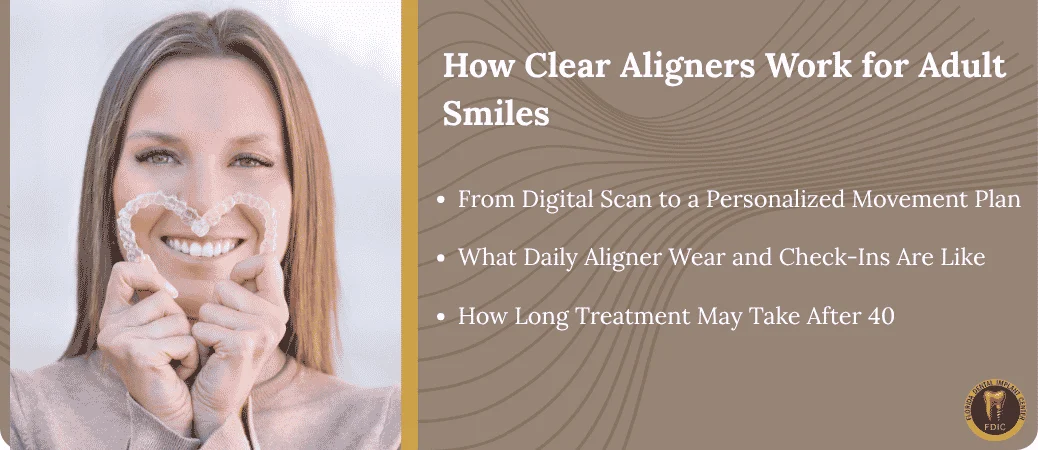
How Clear Aligner Treatment Works for Adult Smiles
Clear-aligner treatment begins with a digital scan and uses a series of custom trays that apply controlled pressure to move your teeth in planned stages.
From Digital Scan to a Personalized Movement Plan
Your first appointment usually includes a digital scan instead of the old-style putty impressions.
That scan builds a 3D model of your teeth, which your orthodontist uses to map out a full sequence of tooth movement from your starting position to your goal.
A digital scan captures the position and shape of your teeth, existing restorations, and visible wear patterns.
Your dentist may use dental X-rays and a clinical examination to evaluate the supporting bone and gum health.
What Daily Aligner Wear and Check-Ins Are Like
Clear aligners need to be worn close to all day, with removal only for eating, drinking anything besides water, and cleaning your teeth. Consistency is what makes the treatment work.
Flossing and brushing after meals before putting trays back in also protects your gum health throughout treatment.
Check-in visits let your orthodontist confirm teeth are tracking as planned and gums are responding well.
The timing of progress visits depends on the treatment plan and whether your teeth are moving as expected. If you ever have severe pain, swelling, or a broken tooth between check-ins, don’t wait for your next visit. Contact an emergency dentist right away.
How Long Treatment May Take After 40
Treatment length varies according to the amount of movement needed, bite complexity, and consistent aligner wear.
Florida Dental Implant Center notes that clear-aligner treatment commonly takes between six and eighteen months, but your dentist will provide a personalized estimate.
Are Clear Aligners or Braces Better for Your Case?
Clear aligners work best for mild to moderate crowding or spacing, while traditional braces offer more control for complex bite corrections.
The right choice depends on what your exam shows, not on which option sounds more appealing.
| Factor | Clear Aligners | Traditional Braces |
| Best for | Mild to moderate crowding or spacing | Complex bite or crowding cases |
| Visibility | Nearly invisible | Visible metal or ceramic brackets |
| Removable | Yes, for eating and cleaning | No, fixed in place |
| Oral hygiene | Easier, brush and floss normally | Requires extra care around wires |
| Control over movement | Good for planned, gradual shifts | Precise force on individual teeth |
When Aligners Can Be a Strong Fit
Aligners suit adults with mild to moderate crowding, minor spacing, or a bite that has drifted slightly out of alignment since a childhood orthodontic treatment.
Many adults also like that trays are removable for client meetings, dinners, and daily oral hygiene.
When Traditional Braces May Offer More Control
Metal braces may offer more control for certain complex tooth movements or bite concerns. Your cosmetic dentist can compare them with clear aligners based on your examination.
Why Consistent Wear Matters More Than Convenience
Clear aligners generally need to be worn for 20 to 22 hours each day, or according to your dentist’s instructions. Inconsistent wear can delay progress or prevent teeth from moving as planned.
An adult who is inconsistent with wear time can see slower progress or unpredictable results compared to someone who wears braces, since braces stay on regardless of daily habits.
Choosing aligners means committing to that discipline, not just enjoying the convenience of removing them.
A Healthy Foundation Makes Lasting Results Possible

A straighter smile lasts when the gum health and bone support underneath it stay strong.
Clear aligners can move your teeth into better positions, but that result depends on the periodontal health your dental team confirmed before treatment even began.
Keeping up with flossing, regular cleanings, and any periodontal maintenance your dentist recommends protects the investment you have made.
Wearing retainers as directed after treatment keeps teeth from drifting back toward their old positions, which is common without that follow-through.
For many adults over 40, the goal extends beyond straighter teeth. Clear aligners may also be included in a personalized smile makeover treatment plan when alignment and other cosmetic concerns need to be addressed together.
A confident smile you feel comfortable showing in photos, meetings, or everyday conversations is often the reason people finally start treatment they had been considering for years.
Florida Dental Implant Center builds every adult orthodontic plan around that same idea: address the foundation first, then let the smile follow.
Frequently Asked Questions
Can I align my teeth at 40?
Yes, you can align your teeth at 40 as long as your gums, bone, and teeth pass a thorough exam. Age itself is not a barrier; the health of your supporting tissue is what an orthodontist checks first.
Are clear aligners worth considering in your 40s?
Clear aligners may be worth considering if you have suitable alignment concerns, healthy gums, and enough bone support. Their removable and discreet design can fit well into many professional and social routines.
Do clear aligners work as well as braces for adults over 40?
Clear aligners work well for mild to moderate cases, but braces may offer more control for complex bite corrections.
Your orthodontist compares both options against your specific bite and crowding pattern before recommending one.
Can I get clear aligners if I have crowns, bridges, or implants?
Yes, in many cases, though your orthodontist needs to plan around them carefully. Implants are fixed to the bone and cannot move, so they become anchor points, while crowns and bridges may need special bonding methods for attachments.
Will clear aligners change my face shape?
Clear aligners are designed to reposition teeth, not reshape your jaw or face. Some patients notice their smile and lip support look fuller once crowding is corrected, but dramatic face shape changes are not a realistic expectation.
How long do clear aligners take for adults over 40?
Florida Dental Implant Center notes that clear-aligner treatment commonly takes between six and eighteen months.
Your timeline will depend on the amount of correction needed, bite complexity, oral health, and consistent aligner wear.